
Also Available On:






Online Links
David Cross is FED UP With Bill Maher’s BS (video)
We Aren’t Paying Enough Attention to What the SCOTUS VRA Decision Means for State Legislatures
Supreme court’s Voting Rights Act ruling cited misleading data from DOJ

Show Transcript
Click here to read full transcript
[0:04] One of my political antagonists, who couldn’t pass up using the state to attack all kinds of marginalized groups, lost his bid to be the Republican nominee for Ohio’s 9th Congressional District.
[0:17] And we look at some of the other results from the May primary election in Ohio. Then we look at a recent interview Bill Maher did where he repeats a lot of transphobic myths. Then we consider the implications of the recent U.S. Supreme Court case, Louisiana v. Callas that finally gutted the Voting Rights Act. This is Secular Left with Doug Berger an independent religion-free progressive viewpoint on topics of the day.
[1:00] I live in Ohio, and it is a state that is controlled by the Republican Party. They have the governorship, the state legislature, they have a super majority in the state legislature, and they also now control, well, they have been, they control the courts.
[1:20] The Ohio Supreme Court. The Republicans have been in control of the statehouse in Columbus since 2011. And what they did was, you know, we see in the news recently about these different southern states now that they can discriminate against black voters have gone hard to try to redraw their maps to disenfranchise their black populations. And Ohio went through a similar redistricting in the way that the Republican Party was trying to solidify their supermajority. Now, based on voter records, voter turnout, Ohio is not a red state. It’s more of a purple state. You have more of an equal divide. I believe it’s like 54 to 44. It’s like 54 Republican to 44 Democrat voting records recently. And so we should have that similar breakdown in districts.
[2:33] But we don’t. We have for the Ohio House, it’s like 64 to 35 or something like that. It shouldn’t be that way. It should be like 54 to 44 or whatever that ratio is. That’s how it should be in the Ohio House, but it’s not. And so after the 2020 census, the Republican supermajority was in control of the ballot commission and drew the maps. And it was an illegal map because they really put it to people to get Republican safe seats. And the progressives and the Democrats sued to try to get them to use a fair map. And Ohio’s map at the time, after the 2020 census, I’m sorry, it was after the census. And so you’re looking at 2021 is when it started. 2022 is when they were voting on new maps that were to go into effect for 2024 election.
[3:38] And the Republicans drew the map. There was a lawsuit that went to the Ohio Supreme Court. And the Ohio Supreme Court ultimately ruled at least five times that the map was illegal and that they had to go back and redo it. And each time that they lost in the Ohio Supreme Court, the Republicans did nothing. They dragged their feet.
[4:06] They ignored the court. And again, this is a common argument. A common Republican playbook is that you run out the clock because they knew that if they just waited long enough, that Ohio would be forced to use those illegal maps. And that’s exactly what happened. The Democrats and the other people that had sued dropped the lawsuit so that the maps could be used for 2024.
[4:34] And because of the redistricting amendments to the Ohio Constitution, because both sides didn’t agree on the new map, then the new map would be good for at least two years, and then they’d have to go back and do it again. So at least for two years, they would get to add onto their supermajority. The other thing that happened too was that the Ohio Supreme Court justice, who was a Republican, who joined the Democrats to vote down the maps, had to leave office because I believe she reached the age limit. There’s an age limit to being a justice on the Ohio Supreme Court. And they replaced her with a more compliant Republican, someone who wasn’t going to vote with the Democrats. So with their super, super, super majority assured, that’s how we got the districts that we are currently operating on for now. And we just recently, on May the 5th, we had our…
[5:46] Primary or election primary for the November election. And some of it turned out pretty good for secular people. Well, it was good for, I would think it was good for me because a couple of some of my nemesises and some of the outcomes in the primaries were okay because some of the Christian nationalist extremists, the ones that always seem to cause the problems with the Christian nationalism in the Ohio legislature, they lost their primaries. It wasn’t enough. We still have quite a few people that are still left. And the people that lost their primaries, the people that might get their jobs, we’re not sure about them. We’re not sure if they’re going to be worse or not. So one of the big pieces of news was that Representative Josh Williams, of my area, the Toledo area.
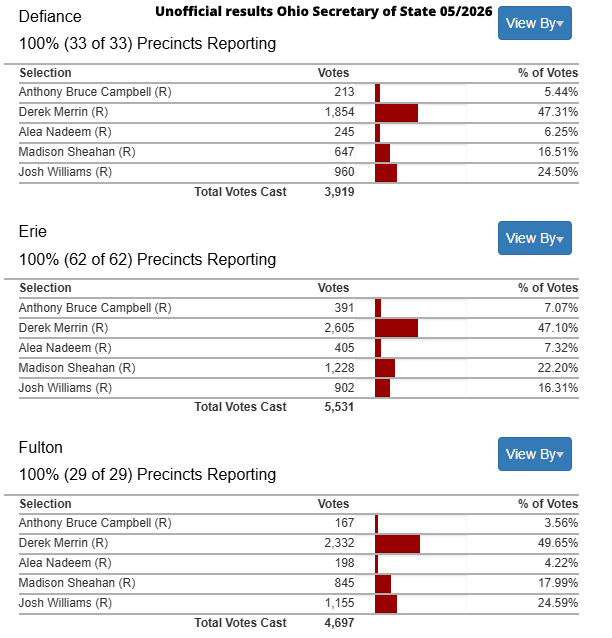
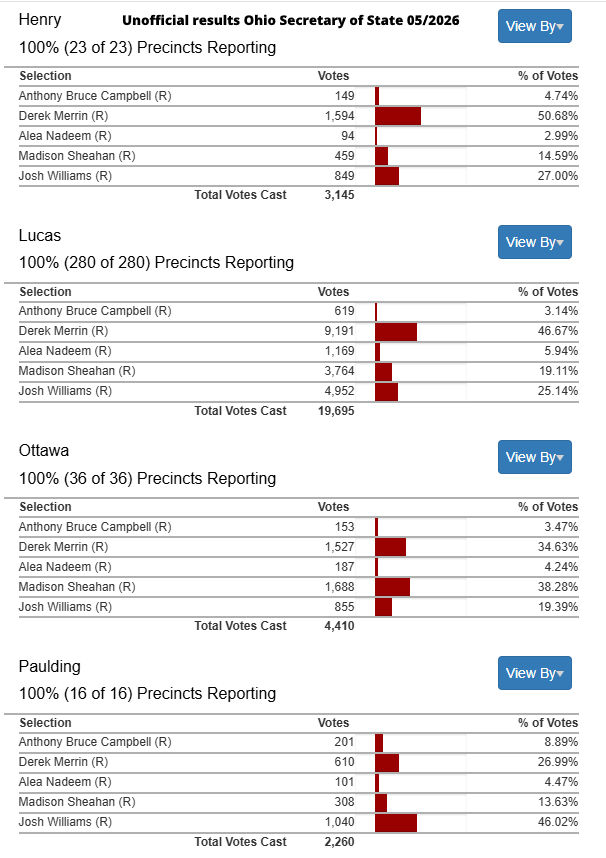
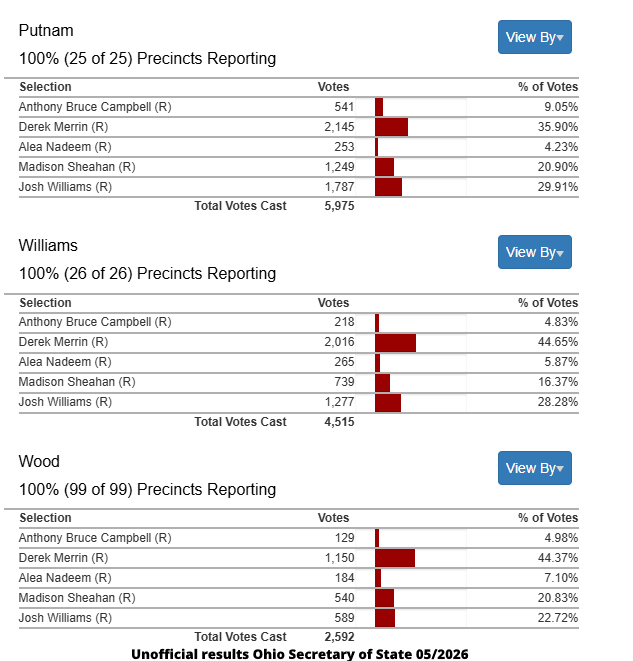
[6:49] Was running for the Republican nomination to run for Congress in the 9th District, and he lost. He lost, it was Derek Maron, and I believe people remember that I’ve talked about Derek Maron before. He is the son of a pastor who’s no longer living, who was very anti-LGBT. Derek Maron is also just like that. He’s a very conservative Republican Christian nationalist as well. And he beat Josh Williams. And then there was three other people, including Madison Sheehan, who was Kristi Noem’s deputy for ICE. She was running. She got third place. And then there was a woman who was a former Air Force pilot. She got the fourth spot. And then there was some random dude, some guy I’d never heard of before who got fifth.
[7:56] And Derek Maron won the nomination with, I believe it was 44% of the vote. So that means over 50% of Republicans in the 9th District did not vote for Derek Maron. And now they’re going to possibly, probably, most likely vote for him in November, even though they didn’t want him as the candidate. Because that’s how Republicans roll. They vote for the people that they didn’t like in the first place because party politics means more than anything. But I was happy, actually, that Josh Williams lost. He didn’t even win his home county, Lucas County. He lost to Marin in Lucas County.
[8:41] And so that was just extra, you know, that was extra sauce on the gravy, man, that he couldn’t even win his home county. And I knew that he was going to have a tough time. He really leaned into that Christian nationalism, the drag band. He supported bills attacking trans people. He was always about parental rights. And and and then he did some good things like he worked on some bills for judicial reform because he’s a lawyer. And so, you know, I gave him props to that. But but all in all, though, he he really leaned into that bigotry, that religious bigotry about people that, you know, for for a token black man in the aisle legislature, because that was the other thing. He is the only black person in the Republican caucus in the Ohio House. The only one.
[9:45] Believe it or not. And so basically what had happened was he got started in a district that had no incumbents. After the 2020 census, before the current maps that are being used now, but the previous maps, they had redistricted the house districts, had a new district in Lucas County that ran from Oregon to Sylvania Township area and along with Point Place, which is a hoity-toity area. And there was no incumbent because it was a newly created district. And Josh Williams basically slipped in. He was a black man, but he was running as a Republican. So he appealed to two different constituencies because sometimes people will vote for women or blacks, no matter what their politics are, as long as they’re not extremists, you know. And at the time, he was not an extremist. So that’s how he initially got into the statehouse. Then when they read district again, and that was the map that we’re currently using.
[11:03] His district moved across the Maumee River more into the western part of the county, Lucas County. And the western part of Lucas County is primarily white, majority white.
[11:22] And so I knew that he was going to have a problem running for the 9th District, And because most of the ninth district also shifted west into the western counties and those rural people in northwest Ohio, they’re not they’re not Ku Klux Klan racist.
[11:45] But they’re less likely to vote for a black person than they are to vote for a white man. And that’s exactly looks like that’s exactly what happened. So no matter how much Josh Williams played up his Christian nationalist card and all the support that he got from the different religious groups and like the Toledo Right to Life Coalition and and people like that, he still couldn’t overcome the fact that he was black running in a majority white district. And so I knew he was going to have a problem, especially if you had multiple people running. And so I looked at the results and the vote totals for all the other ones, like Shane and the other woman and that random dude, put together with, if they had all voted for Williams, Williams probably would have won the nomination. But as it is, Derek Maron skates through like he normally does by splitting the ticket. And my conspiracy theory was working overtime thinking that he had something to do with the multiple people running. That’s how I was thinking, because that’s how evil Derek Maron is.
[13:05] So that was good. The other nemesis of secular people was Josh Williams’ partner in crime on the Christian nationalist front, Reverend Gary Click over in Fremont. He barely, actually barely won his primary. I was shocked. The person that he was running against, I think his last name was Watson, was 10 times more extreme than Gary Click.
[13:38] But I don’t think he was as ambitious. I don’t think this guy was as ambitious as Gary Click. So Gary Click ended up winning something like 54% to 44%, something like that. It’s very close. For a staunchly Republican district, that was very close. For him, because usually Republicans don’t like to have primaries. Parties don’t like to have primaries. You know, that’s why they gerrymander the way that they do is they’re trying to get safe districts. So that was, I was pleased at how, um.
[14:19] I was pleased at how close the click primary was. So hopefully there’s a good chance that maybe the Democrat might win in November. Who knows? There’s a Democrat from, I believe, from the Fremont area that’s running against him. And people tell me that this guy is well-liked and well-known in the area. So he might have a good chance. We’ll see. Oh, and the other thing I needed to point out about Josh Williams is the reason why he was running for the 9th Congressional District is he was term limited at the Ohio Statehouse. So his term in the legislature ends at the end of this legislative session, I believe at the end of the year. Williams’ outcome, I like that. Clicks, I was kind of happy about it, but it would have been better maybe if we got the ultra-extreme guy. Who knows? One of the other outcomes that I really thoroughly enjoyed was the primary for current Ohio Senator Andrew Brenner. Andrew Brenner is the guy that used the budget process to give us religious release time, religious instruction policy in the state of Ohio.
[15:36] I worked on that bill or opposing that bill when it was HB 45 a couple of years ago. And we thought we had it stopped and it went to the Senate and it looked like it was going to be bogged down. And Andrew Brenner ended up putting it, including it into the budget bill.
[15:54] And got it passed because he knew it wasn’t going to pass on its own.
[16:00] That’s another trick that Republicans do here in Ohio is if they have a controversial law that they want passed, they’ll put it into the budget. And the reason why they do that is because they don’t have to have any public hearings about it. They get to vote on it, and it can’t be undone. You can’t have a referendum to remove it once it’s in the budget. The only way that you can remove it is to include it in a future budget and have it removed in the future budget. So Andrew Brenner was term limited in the Senate and he was working with his colleague, Representative Beth Lear, who was term limited in the Ohio House. And the deal that they got together was that they were going to switch seats. He was going to run for her seat. She was going to run for his seat. And in the primary, he lost and she lost. So that’s two for one. Two Christian nationalist extremists are out. They lost their primary. Now, the people that are going to replace them that actually were nominated, if they get elected, I don’t know anything about them. Standard biographical stuff. So I don’t know how extremists they are. I’m guessing maybe they won’t be as extremists. I know Brenner had his issues.
[17:27] He famously, at least or infamously, was caught on a Zoom court hearing.
[17:38] Driving his car. And the judge said, are you driving your car? And he said, no. And you could tell he was driving his car because he had his seatbelt in the shot. You know, because in Zoom, you can change the background. He had the Zoom background. He had an office scene. But if you looked at his image, his image, he had his seatbelt on. So he got in trouble for that. He should have been disbarred. He got his law degree from Liberty University. So there you go. So I was pretty happy about that. But in general, the primaries did what they were supposed to do and that they.
[18:27] Shortened the list of people that are running in November. And I’m hopefully, fingers crossed, that progressive and liberal people and secular people get a better result in November. Here’s hoping we do.
[18:53] For more information on the topics in this episode and the links used, visit secularleft.us.
[19:13] Bill Maher is a comedian and political commentator who has a pretty sizable following in the Freethought community because he is a supporter of the separation of church and state. I think he’s an atheist. I think he does say he’s an atheist. He’s a libertarian. He’s all about personal freedoms, having the government stay out of your business.
[19:44] And so he, he gets a lot of fans from people like me who like that. Uh, he did a documentary some years ago called religious religious or something. I, I can never figure out how to pronounce it. You can look it up. And basically he went around the country and interviewed a Christian nationalists to find out how they, how they thought. And, The only problem I’ve ever had with him is he tends to be smug and arrogant and make fun of people for no apparent reason. And I know some people would agree that we don’t need to do that all the time. And some of the people complain that we’re bashing religious people. And I can see their point on some of the stuff that Bill Maher’s done with regards to religion.
[20:44] Well, he has, obviously he has his political talk show on HBO that he does where he has a panel discussion and then he does like a segment called New Rules and I haven’t really cared for his political talk for some time. I used to watch him. He had a political talk show similar to what he’s doing now on ABC, on the ABC network in the 90s. And he used to bring on people like Ann Coulter and some other conservatives that I really don’t care to hear. With this notion that, you know, talking, you know, getting all sides of a story and having both sides talk and make their case. And I just was, it just depended on the topic, but usually I just didn’t want to hear from the conservative side. Then 9-11 happened and he made some comments, which were valid comments about Muslim suicide bombers, and his show was canceled.
[21:58] And so he was like the first Jimmy Kimmel, the first of the Jimmy Kimmels, where the government forces a television network to get rid of somebody that they didn’t like. And that’s kind of what happened. So.
[22:16] So he’s doing this political commentary, and then he has, for lack of a better word, it’s a podcast. It’s on video, but it’s not broadcast on HBO or anything. And it’s called Club Random, and basically he has on single guests, and they chat, and usually they’re smoking weed or sometimes or drinking alcohol or whatever and talking about issues and just having a chit-chat. So the other day, I caught some clips of an interview that he did with comedian David Cross. He’s one of the creators of Mr. Show. He was on Arrested Development, and he’s done some other comedy bits. I think he’s a funny person.
[23:07] His political views, he’s progressive, liberal, political viewpoint. And again, Bill Maher is a libertarian, but he could be a libertarian curmudgeon, put it that way. He’s all about personal freedom, but he has some very opinionated views. So he’s an interview with David Cross, and they’re talking about, David Cross is a father, he has several children, and they’re discussing his kids, and I’m not sure exactly, because I didn’t watch the whole interview, so I don’t know how this happened. But they started talking about trans kids. And David Cross made the comment that one of his children has black friends and trans friends. And that triggered, seemed to trigger Bill Maher. And he’s like, trans friends? And they get in this whole big discussion about whether or not an eight or nine year old knows that they’re trans. And Bill Maher seems to have the idea that parents are doing this to their kids, making them trans. Now, that’s just a common anti-trans argument.
[24:32] From evangelicals, from Christian nationalists. That’s the religious people, but you don’t have to be religious to be anti-trans. Uh, there are some people in the free thought community, Richard Dawkins, one of them that are also anti-trans. So that’s like a common everyday occurrence. So I’m going to, what I want to do is I have this, this segment from this podcast called The Majority Report with Sam Sater. He used to do Air America for those that are progressive that know about that from, I think that was in the 90s.
[25:10] And he has this podcast. I tend to watch it occasionally, depending on who the guests are and what the topics are. And they were talking about this interview, and they played clips. So this clip of the Majority Report will have clips of the Bill Maher-David Cross interview, so you can hear what Bill Maher is saying.
[25:33] And I wish I could play the whole segment, but that would be unfair to Majority Report. So hopefully I’ve whittled it down to the gist of it so you can get a sense of it. And then I’ll have a link in the show notes for the full segment because they put the full segment up on YouTube. They’re full. Majority reports full segment on this issue. And I agree with Emma and Sam’s take on this completely 100%. And Bill Maher is wrong. Completely wrong. And it’s one of the reasons why I just don’t like Bill Maher and I don’t support him, even though he’s one of my like-minded people. I just think that, you know, I’m of the idea that we are all, we all deserve basic dignity and worth. And if you can’t do that, then you are wrong. If you cannot use proper pronouns, if you’re just so incensed with calling somebody what they want to be called, you’re a bigot. It’s just clear, simple as that. You’re not protecting children. You’re a bigot.
[26:54] And so this is a prime example of what I’m talking about. And I just wanted to play this segment. It’s quite long, probably about five or 10 minutes. This segment is quite long. And please stay for it because I think it’s very important to hear it. Here’s Bill Maher talking to David Cross. Is this the one about the trans? Okay, yeah, here he is. Bill Maher is so worried about little children that he doesn’t have. You need to be checked. People need to be checked. I think they’ll be… Including your little girl. Okay. She needs to be checked. I don’t know what… Fuck that bitch. Fuck that little bitch with her black friends and trans friends and not even understanding. She doesn’t know. Wait, she has trans friends in third grade? Yeah. Yep. Okay. They know they’re trans in third grade. I knew one of her friends i knew when uh he was a girl how old identify uh i i think just turned nine and uh.
[28:03] And is just the coolest kid uh i don’t you know i i think boy girl girl the boy uh girl the boy, Girl to boy And she has another very close friend Who’s not in the school But who’s boy to girl At three Girl to boy I knew somebody who said to me Actually more than one person Who said to me A woman said I was what they called a tomboy If I was alive now And acted the way I did then That’s what they would have done to me.
[28:42] Well, nobody’s doing this to her. Okay. Well, I don’t know. Can I just pause to say as somebody who, yeah, I cut off all my hair for like two years and wanted a stud in one ear, only wore LeBron James, no, it wasn’t LeBron James, it was Shaquille O’Neal Lakers jersey, and was a real tomboy for quite a while.
[29:02] I did not get a lot of pressure to change my gender, and I didn’t end up doing that. It was a phase because I was allowed by my loving mother to show, like, to experience that kind of thing and experience my gender performance. Oh, your mother did that to you, allowed you to cut your hair and wear a boy’s shirt. Yes. Yes. That last I checked, LeBron James is… It was Shaquille O’Neal. Shaquille O’Neal is a boy. Yeah. And a man. And you were allowed to… And your mother did that to you. Yeah. Yeah. To quote Veep, not doing anything is doing something. You know, they’re doing that to you. And that made me think of it a whole different way. But it’s just how he opens this act talking about kids. He has no idea what he’s talking about whatsoever, but speaks with the utmost authority. To a father. He has zero, zero understanding. The idea of people going through, of kids going through a phase or ultimately not it being a phase in allowing them to express themselves. He perceives this as some parent is pushing an agenda on the kid. This, his perspective on parenting is so twisted and it’s even more twisted based upon the fact that he does not have a kid. It’s crazy. It’s, it is. You gotta check these kids. Yeah. Yeah. Go ahead.
[30:27] To the way i did then that’s what they would have done to me well nobody’s doing this to her she well i don’t know literally nobody is doing this to how old uh she is or he is uh either eight or i think nine okay then somebody is doing something because eight or nine year olds.
[30:49] They’re responding to the child and the child says Because I want boys clothes. I want to be addressed as a boy. And the parents are going out and buying boys clothes like they would if she was a tomboy. And the only difference is, is referring to this kid in the way that the kid wants to be referred to. And that’s what they’re doing. Yeah, social transition. And there are numbers on trans-affirming care for kids that just show how infinitesimal this kind of thing is. Lancet had numbers on when they looked at younger kids when they were socially transitioning and beginning that kind of care, that 98 percent continued care as teens, according to Lancet. And then there was also a pediatric study about the very notion of detransitioning, where they looked at kids who had socially transitioned and after a five year period, what they how they ended up.
[31:55] Ninety four percent continue to identify as their socially transitioned gender. The remaining six percent, you can have that. Half of them stopped care and identified as non-binary. So that’s 3%. And the other less than 3%, they decided, yes, I’m going to remain as my birth gender. But that was heavily weighted when analyzing this in pediatrics with kids who were under six years old before they had undergone any bodily changes, any of these hormonal changes. The detransitioning part where kids are exploring their gender identity, yes, that tends to happen when they’re much younger before any of the medical interventions that he’s talking about have even occurred, let alone, even if they’re in the time when kids are experiencing puberty, a lot of this stuff is just hormone blockers and hormone treatments, or I should say puberty blockers and hormone treatments that aren’t the drastic medical intervention that he’s talking about and are used on cis children very frequently, which Bill Maher doesn’t say shit about. But this is also, it also reveals the fact that this has nothing to do with protecting kids or any of that stuff, because there is no physical intervention that’s happening at this point. It’s just simply, I’m going to buy you the clothes you want, and I’m going to respond to you in the way that you want me to. Yeah, she, her.
[33:21] If you would like to buy some secular left swag to show your support and to express your politics, then check out our merch store. We have branded items for sale, such as t-shirts, hats, mugs, and many other unique items.
[33:36] Check it out at secularlet.us slash shop.
[33:45] At the end of April, on April the 29th, Wednesday, April the 29th, the United States Supreme Court ruled 6-3 in a case called Louisiana v. Calais That struck down a Louisiana congressional map that a group of voters who described themselves as non-African American had challenged as a product of unconstitutional racial gerrymandering.
[34:11] They left in place a ruling by a federal court that barred the state from using the map, which had created a second-majority black district in future elections. Although Wednesday’s ruling did not strike down a key provision of the Federal Voting Rights Act as Louisiana and the challengers had asked the court to do, Justice Elena Kagan suggested in her dissent, which was joined by Sotomayor and Kenji Brown-Jackson, that the majority opinion by Justice Samuel Alito had rendered the provision all but a dead letter. And that was from the SCOTUS blog, which is a very knowledgeable.
[34:52] Accurate, non-biased news site that talks about Supreme Court rulings. And then the SCOTUS blog entry also said the decision was the latest and presumably final chapter in a long-running dispute arising from Louisiana’s efforts to adopt a new congressional map in the wake of the 2020 census. The first map that the state adopted in 2022 had one majority black district out of the six allotted to the state. A group of black voters who comprised roughly one-third of the state’s population went to federal court where they alleged that the map violated Section 2 of the VRA, which prohibits discrimination in voting. And it says the map that Louisiana drew in 2024 created a second majority Black district, leading to the election in November of that year of Cleo Fields, a former member of Congress who had represented another majority Black district during the 1990s. What this was is the U.S. Supreme Court majority decision basically says that you cannot gerrymander your congressional districts based on race at all for any reason.
[36:04] And most people would be saying, well, yeah, you shouldn’t be allowed to do that. Well, let me explain something. All right. And as the SCOTUS blog points out, black voters comprise roughly one third of the state’s population in Louisiana. And yet they only had one black majority congressional district out of six. That means that the other five at the time were white majority voters. And so the map that was created in 2024 gave them a second black majority congressional district. So it would have been four to two, which is technically at least one third. Right. I don’t know. My math is terrible. But that but having a second majority black majority district seems a bit more fair than only having one.
[37:16] You know, and I get that. I get that you shouldn’t gerrymander based on race. I get that.
[37:24] However, if you’re going to gerrymander at all, it should be at least fair, right? And it’s not. So basically what the Supreme Court is now going to allow in many Southern states since this ruling have rushed to do is you can gerrymander based on politics. They don’t have a problem with political gerrymandering. So if the Republicans want to create multiple Republican districts, they can now. And same with the Democrats in Democrat majority states. They can get rid of current Republican districts that they don’t, that they can gerrymander them out. Now, personally, and as a part of my principles, I oppose gerrymandering anyway, for any reason. You know, gerrymandering is when you manipulate the data and manipulate the lines of the congressional districts for the advantage of other people, for other groups, for whatever group is doing the map drawings. You know, there is a more fair and neutral way of drawing congressional maps than what they can currently do now.
[38:51] But I will say, if you’re going to gerrymander based on race, which is what Louisiana is doing, whether they specifically say that or not, then the number of congressional districts should match the population based on race. So if you have six districts and you have a black population of one third, you should get at least two congressional districts that are black majority. At least. It would be better to have three, but that would be 50 percent. But this Supreme Court case, and it’s a culmination of 20 to 30 years of conservative attacks on the Voting Rights Act that led by Chief Justice John Roberts. Because when he worked for the Department of Justice, I think it was during either Nixon or Reagan, that was his jam, was doing everything he could to dismantle the Voting Rights Act. And here’s a better way of explaining what’s going on, okay?
[40:05] Kind of give you an analogy. Uh, one of the jobs I had years ago was I worked in customer service for a pharmacy benefit manager that acted, it was based, basically an HMO, if people are familiar with HMOs. And so you control costs, quote unquote, control costs by having burdensome rules and regulations so you can deny claims to people so that you don’t spend any money. I, yeah, I’m I had a ethical problem with working and working that job at times because of that. And so I would get phone calls and it was a pharmacy manager, benefit manager. So basically the phone calls I would get from people would be when they would go to pick up medications and it wouldn’t be covered for whatever reason.
[41:06] Um, most of the time it wasn’t covered because it was, um, needed pre-approval, uh, pre-authorization and they didn’t get it. The other reason would be we had this thing where they kept tabs on how often you had your medication refilled and you had a certain, um, it was a buffer. So you could get your medication refilled seven days early, but then that would change your refill date minus seven days. Well, people that are getting their medication refilled early are getting it refilled early because they either lost the medication or they’re taking too much or something. And so they’re running out. So instead of going back to their doctor to have the prescription redone so that they have the proper amount, then they just keep getting it earlier and earlier. And pretty soon you wipe out that buffer. And so you go the next time, seven days, which is now probably 21, 24, 28 days early.
[42:16] And the insurance won’t pay for the medication. All right. So basically what happened, what I was told to tell people and, and do this as nicely as possible is I would explain to them, uh, Mr. Mr. Smith, we are not keeping you from getting that medication. You can still obtain that medication. We are just not going to pay for it.
[42:45] Now, technically, that is the case. And if they don’t get their medication, that’s on them, technically. But ethically, that is kind of how this Louisiana Supreme Court case, you know, we are going to discriminate you against you in gerrymandering your congressional districts, because you’re a Democrat or because you’re a Republican, not because you’re white or because you’re black.
[43:18] So because we’re doing it because you’re a Democrat, then that’s legal, even though most Democrats in Southern states are black people. So in the end, the end, the outcome is that you have discriminated against black people. You’ve just dressed it up, or how they used to say, put a lipstick on a pig. And that worked the same way with my customer service job with the pharmacy benefit manager, is those people were using their insurance to get their medication because they couldn’t afford their medication any other way. And so if the insurance wasn’t going to pay for it, they weren’t going to get it. And we were keeping them from getting it, even though technically that wasn’t the case. So that is the gist. And so somebody will say, well, it is unfair to gerrymander away from white people, you know, to create these all black or black majority congressional districts. And all I can say to that is that the civil rights laws and the Voting Rights Act were created in the 1960s to address systemic racism. Hundreds of years of racism.
[44:45] Where people were enslaved. Then we had a civil war and then they were freed. Then Jim Crow came in and discriminated against them again. Even though they were free, they weren’t slaves. They still were second class citizens. They got less resources. Their schools were crappy. They didn’t have generational wealth because they couldn’t own property because they didn’t have any money that got passed down from, people from within the family. And it was all by design. This just wasn’t happenstance. It wasn’t the fact that they were inferior people. That’s what some white supremacists would say. No, it was a systemic system set up to discriminate against black people. The GI Bill didn’t apply to black veterans in some cases. Mortgage agency that gave mortgages to guys returning home from the war, they didn’t give those loans to black people. Black people couldn’t buy a house that was eligible for those loans.
[46:03] And and that was in like parts of the New Deal didn’t apply to black people. So there and a lot of times they did that to get southern legislators to sign off on some of these things like the New Deal stuff. And during the Depression, well, yeah, we want to help out people, but we’re not helping black people because they’re lesser than we are. They don’t deserve it. You know, and you see that with the SNAP benefits. You know, they think that a majority of black people use SNAP benefits, so they punish poor people for using it. It’s your poor choices. So it’s all about control. This case, this Louisiana case was all about control. It’s not about. And so the court was the court has said in the past that racism is over. The racism that brought forward these laws are over, so they’re not needed anymore. And just because we elected a black president, racism didn’t go away. You know, the election of Donald Trump is proof of that.
[47:16] The things that he’s been doing is proof of that. You know, how could you go from electing the first black president of the United States, to then electing the most white supremacist racist president the United States has ever seen since before the Civil War? You know, at least Woodrow Wilson was subtle in his racism when he segregated federal agencies. You know, look that up, Google that. But here we have an administration led by Donald Trump who was sued for racial discrimination in his housing business, his rental business. We see a repeat of this stuff. And it’s just so telling that all these southern states are clamoring now to go back and redraw their maps for the upcoming election so that they can get rid of the black majority congressional districts that exist currently in their red states. So I hope that the Democrats do the same thing on their end.
[48:27] But what we really need, though, is we need to end this gerrymandering stuff completely. And I think there ought to be a law, a national law against it. And that if they do it, if they do, if they draw congressional districts, it has to be fair. It has to be independent of the politicians, and it has to address the population centers and not the politics. For more information on the topics in this episode and the links used, visit secularleft.us. If you want to support the show, share it with your friends or visit our merch store at secularleft.us.shop. See you next time.
Transcript is machine generated, lightly edited, and approximate to what was recorded
Secular Left © 2025 is licensed under CC BY-NC-ND 4.0.
Credits
Produced, written, and edited by Doug Berger
Our theme music is “Dank & Nasty” Composed using Ampify Studio
