Tag: 1st amendment

May 30, 2012
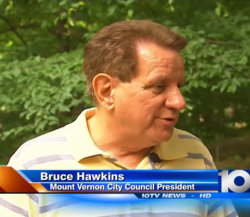
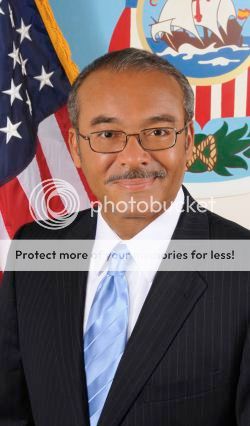
screencap of Council President Bruce Hawkins

There is yet another dust up about a city council saying Christian prayers before meetings. Mount Vernon Ohio City Council previously held prayers at the beginning of their meetings then a resident sent a letter of complaint. Once the other people in town heard, then they complained about ending a “tradition”. Add to that mess is the comments the city council president made in a story on a local TV station – that he pledged an oath to God so he sees no problem with having the prayers during the meetings. He’s wrong of course.

Resident Ryan Kitko sent a letter of complaint to the council. He claimed – factually – that Christian prayers at the meeting slighted those who weren’t Christian or who had no religious beliefs.

April 4, 2012
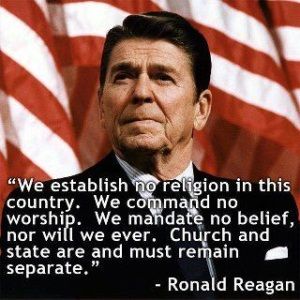
quote image of President Reagan supporting separation of church and state

I had a Facebook friend post the image to the right of this text that shows a quote from President Ronald Reagan that seems to support the separation of church and state. I like to check these kinds of things out because I don’t want to pass on a false quote. When I found out where the quote came from, the story is a lot bigger than this small 300×300 image. Learning the full story shows a classic politician speaking out both sides of his mouth.

January 10, 2012
image of the logo for Religious Freedom Day

January 16th is National Religious Freedom Day. The day commemorates the Virginia General Assembly’s adoption of Thomas Jefferson’s landmark Virginia Statute for Religious Freedom on January 16, 1786. The Virginia Statute was the basis of the 1st Amendment of the US Constitution and also can be used to support Jefferson’s idea of the separation of church and state. The Religious Right have of course co-opted the day by mass marketing misleading information about what real religious freedom means in this country. Luckily, Americans United for Separation of Church and State (AU) has some help available to tell the truth.

The Virginia Statute for Religious Freedom was passed at a time when state support and protection of churches was the norm in what would become the United States. Thomas Jefferson offered the statute as a way to protect the church and the state. It is obvious from reading the text that separating church and state was the goal.

October 30, 2011
Image of President Obama speaking

Joshua DuBois, Executive Director of the White House Office of Faith-Based and Neighborhood Partnerships, responded to two recent citizen petitions asking that ‘In God We Trust’ be removed from the currency and ‘Under God’ be removed from the Pledge of Allegiance. As I expected, DuBois makes a long reach to justify rejecting the petitions.

One recent method of citizen engagement that the Obama administration is trying is called “We the People” that harkens back to the Declaration of Independence and our current right to petition government for redress of grievances. The White House set up a website for people to create petitions on issues and the administration promised to respond if the petition got a certain number of “signatures”.

October 10, 2011
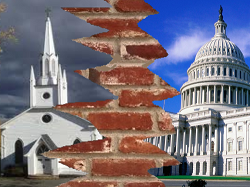
The fragile wall between church & state

Back in July I posted about a discrimination case involving a fired teacher at a church school in Redford Township, Michigan. She was fired after a long medical leave. The case was heard by the US Supreme Court on Wednesday October 5th. Instead of trying to argue under the religious clauses of the 1st amendment, the government is using an argument under the freedom of association clause. That choice seemed to shock the justices. I think it is brilliant – if it works.

September 13, 2011

Image of a generic angry mob
Supporters of Sharia Law ban
In the 2010 general election, voters in Oklahoma passed a ballot measure that attempts to ban Oklahoma courts from considering Islamic laws in the their decisions. The law was blocked when the Council on American-Islamic Relations (CAIR) and ACLU sued. They claim the law violates the 1st amendment of the US Constitution, the Oklahoma Constitution, and the Oklahoma Religious Freedom Act. This story shows that those who support the ban have a bigoted idea of Sharia law and have little knowledge of what our civil rights actually are.